
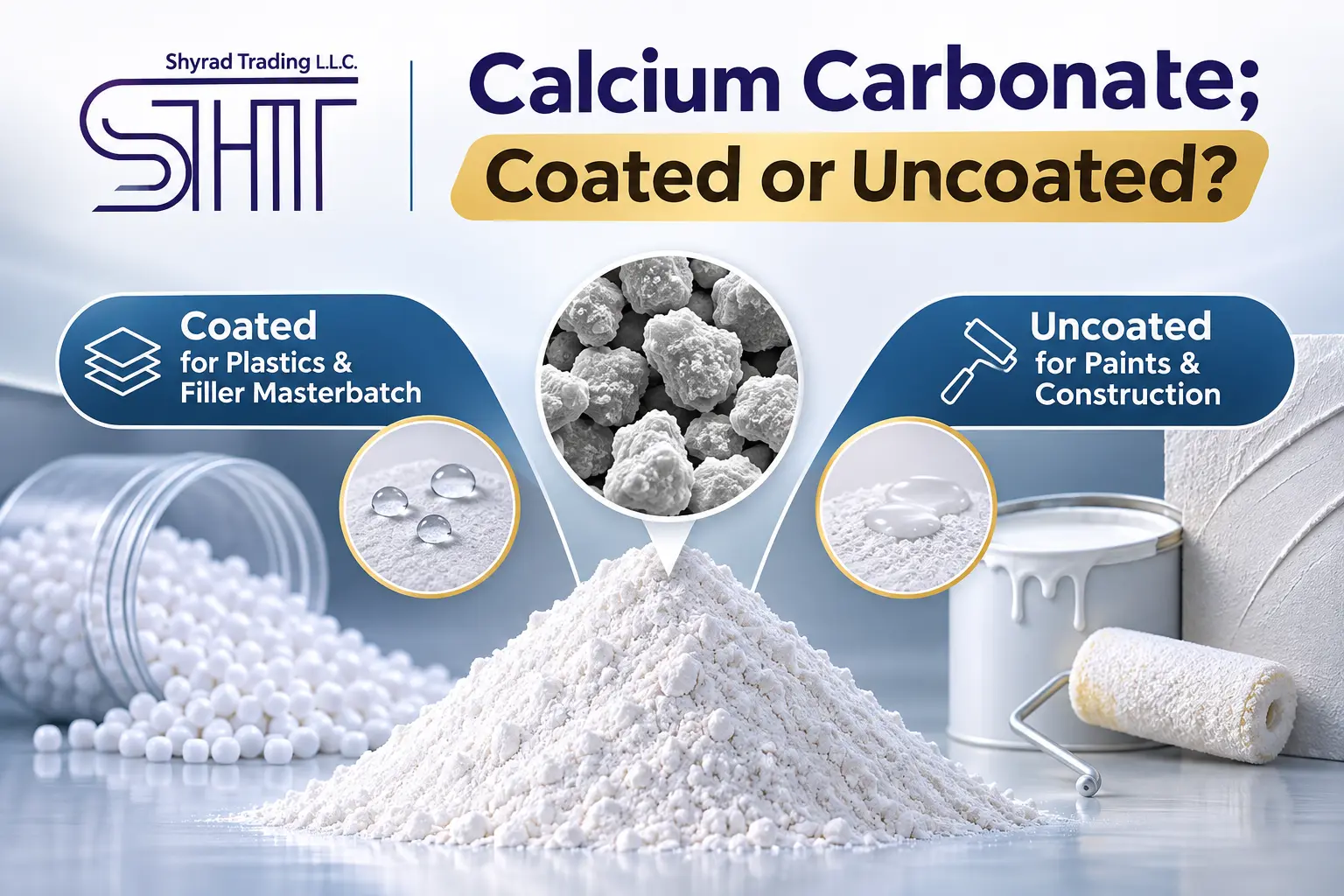
Calcium Carbonate; Coated or Uncoated?
Coated calcium carbonate is often the starting point for polyethylene and polypropylene filler masterbatch. Uncoated calcium carbonate is commonly used in cementitious dry-mix mortars, waterborne paints, paper, and ceramic glazes. The choice comes down to how the mineral surface interacts with the surrounding material, whether that is a polymer melt, a water-based formulation, or a batch that will be fired. patents.google.com
For procurement managers and industrial buyers, coated or uncoated is the first decision in a broader specification. Two calcium carbonate powders can have the same median particle size and behave differently on the production line because they differ in coarse particles, moisture, brightness, or surface treatment. Matching those properties to the application makes it easier to compare supplier offers and qualify a grade for repeat orders.
What Is the Difference Between Coated and Uncoated Calcium Carbonate?
Ground and precipitated calcium carbonate
Ground calcium carbonate (GCC) is produced by milling and classifying natural materials such as limestone, marble, or chalk. The mineral source and processing determine properties such as purity, color, and particle size distribution. Precipitated calcium carbonate (PCC) is produced through controlled chemical precipitation, commonly by reacting carbon dioxide with calcium hydroxide. The process gives producers greater control over crystal shape and particle characteristics. Both GCC and PCC can be supplied with a surface treatment. Shyrad trading L.L.C
What surface treatment changes
Uncoated calcium carbonate retains its mineral surface without an intentionally applied coating. It is generally easier to wet with water than a conventional fatty-acid-coated grade, although good dispersion may still require appropriate mixing and a dispersant. This makes uncoated GCC a common starting point for cementitious materials and many water-based formulations. cronfa.swan.ac.uk
Coated calcium carbonate has a surface treatment selected for a particular formulation. In polymer applications, a common treatment uses stearic acid or a fatty acid blend to make the mineral surface more hydrophobic and easier to incorporate into a compatible polymer melt. How well it disperses also depends on the particle size distribution, coating chemistry, filler loading, and mixing conditions. Confirm the treatment with the supplier, since the term coated alone gives little information about compatibility. Justia Patents Search
Coated Calcium Carbonate for Filler Masterbatch and Plastics
Polyethylene and polypropylene filler master-batch
A calcium carbonate filler master batch is a concentrated blend of mineral filler in a carrier resin. The compounder supplies it as pellets, which the converter blends into the base polymer at a dosage selected for the finished product. Coated GCC is commonly evaluated for PE and PP master-batch because the treated mineral surface can improve incorporation and dispersion in these polymers. Typical applications include blown film, woven sacks, and molded products. The carrier resin should suit both the base polymer and the conversion process. Omya
Keep the mineral content of the master-batch and the mineral content of the finished article separate when specifying a grade or reviewing a trial. The final loading depends on the mineral concentration in the pellets and the proportion of pellets added to the base resin. Trial results are comparable when both values are known. A film producer should also distinguish pellet quality from film performance. Uniform pellets can still produce a film with visible specks or an unacceptable change in tear strength at the intended dosage. patents.google.com
Blown film and rigid plastic products
Thin film is particularly sensitive to coarse particles and agglomerates. A satisfactory median particle size can conceal a coarse fraction that contributes to visible specks, surface defects, or film breaks. When qualifying calcium carbonate for blown film, review the upper end of the particle size distribution and the sieve residue, where relevant. Run the trial at the intended film gauge and filler loading, then assess surface appearance, tear and tensile properties, and production stability. Where transparency matters, include haze in the evaluation. patents.google.com
For rigid plastic products such as PVC profiles or PP molded components, calcium carbonate can increase stiffness and change how the compound processes. Impact resistance can respond differently depending on the polymer, particle size, dispersion, and loading. In rigid PVC, evaluate the filler within the complete stabilizer and lubricant package and check its effect on fusion and extrusion. A grade approved for a thick molded part should undergo a separate qualification before use in a thin film or a profile with a demanding surface finish. Justia Patents Search
Uncoated Calcium Carbonate for Construction and Dry-Mix Mortar
Tile adhesives, wall putties, and self-leveling compounds
Uncoated GCC is widely used as a mineral filler in dry-mix mortar, including cementitious tile adhesives, wall putties, renders, repair mortars, and self-leveling compounds. The right particle size distribution can fill spaces between coarser particles and help control packing, workability, and finish. An ultrafine grade may provide nucleation sites for early cement hydration. The response depends on how its particle size and surface area fit the rest of the mix. A finer powder can increase water demand if it adds more surface area than the formulation can accommodate at the target consistency. omya.com
The specification should reflect how the mortar will be used. A skim coat requires a smooth finish and good spreadability. A tile adhesive must meet its requirements for open time, slip, and adhesion. A self-leveling compound needs adequate flow and resistance to segregation. Test the candidate filler in the complete formulation, including the cement, sand, cellulose ether, and any redispersible polymer powder. Their combined effects determine how much water the mix needs and how it behaves during and after application. omya.com
Limestone filler and cement replacement
Limestone powder can be used as an added filler or as a partial replacement for cement in a designed binder system. Those changes affect the mix differently. Replacing cement also reduces the amount of clinker available for hydration. Improved packing and early hydration can offset some effects of that reduction, depending on the cement chemistry, replacement level, and fineness. When changing the filler content or cement dosage, verify strength and any durability requirements at the relevant ages. Conventional uncoated limestone filler is a practical starting point for water-mixed cementitious systems. cement.org
Other Industrial Uses of Coated and Uncoated Calcium Carbonate
Paints, coatings, adhesives, and sealants
In waterborne paints, uncoated GCC is commonly used as an extender to adjust sheen, texture, and formulation cost. The grade can also affect opacity, viscosity, and wet-scrub resistance. Fine grades may help optimize how titanium dioxide performs in some formulations. The finished paint still needs to meet its specified hiding power, gloss, and application properties, so compare candidates in the same binder and pigment system. Omya
In adhesives and sealants, filler selection depends on the binder, cure chemistry, and desired flow. Surface-treated GCC or PCC can be suitable for some nonaqueous systems, while uncoated grades may be suitable for water-based products. If the sealant needs to resist sag while remaining easy to extrude, assess both properties in the same trial. Moisture, particle size, and surface treatment are useful screening criteria, especially for moisture-sensitive formulations. omya.com
Paper, ceramic glazes, and glass
In alkaline papermaking, GCC can serve as a filler within the paper sheet or as a pigment in a coating applied to the sheet. In this context, paper coating describes where the mineral is used. It is a separate specification from the fatty acid treatment used on some calcium carbonate powders for plastics. |
In ceramic glazes, uncoated calcium carbonate, commonly called whiting, supplies calcium oxide during firing and releases carbon dioxide as it decomposes. A grade change can affect the fired result if the calcium carbonate content, impurity profile, or particle size differs. In fast firing, gas release can contribute to pinholes or blisters if the glaze seals before the gas escapes. A firing trial using the production cycle can reveal effects that powder analysis alone cannot capture. In soda-lime glass, limestone also supplies calcium, with grade selection based on the batch chemistry and particle size requirements. digitalfire.com
How to Specify Calcium Carbonate for Industrial Purchasing
Compare technical data on the same basis
Request a technical data sheet (TDS) to compare grade characteristics and a certificate of analysis (CoA) to review the results reported for a specific lot. Ask which TDS values are typical and which are guaranteed limits. A short purchasing specification should identify the properties that affect production, along with the agreed test methods and acceptance limits. This gives the receiving team a basis for deciding whether a shipment matches the approved grade.
| Parameter | What to check |
| Particle size distribution | Compare the median size, d50, and an upper percentile such as d97 or d98. Confirm the measurement method, since instruments and dispersion procedures can give different results. |
| Sieve residue | Specify the sieve aperture and retained fraction when oversize particles can affect film appearance, surface texture, or finish. |
| Moisture | Agree on the test method and limit for moisture-sensitive compounding or storage. Include packaging requirements where moisture pickup is a concern. |
| Purity and impurities | Specify CaCO₃ content and any relevant limits on iron-bearing impurities, insoluble matter, or other constituents that affect the formulation. |
| Brightness or color | Use an agreed optical measurement when shade consistency matters. Compare brightness values measured on the same basis. |
| Surface treatment | Confirm whether the grade is uncoated or treated. For treated grades, ask for the treatment family and how the supplier verifies consistency. |
Approve the grade under production conditions
Use an approved grade as the reference and change one variable at a time where practical. For masterbatch, record the carrier resin, loading, and extrusion conditions. For mortar, record the formulation, water addition, and mixing procedure. Compare the finished product against the performance limits used for routine production. If changes to the quarry, grinding process, or coating treatment could affect results, agree with the supplier on change notification before placing repeat orders.
Compare the delivered cost per tonne of usable material alongside the quoted price. Packaging, freight, handling losses, and production yield can affect the economics. A grade that appears cheaper per tonne may cost more in practice if it increases film scrap, requires additional screening, or forces a change in water demand and admixture dosage.
Why Choose Shyrad Trading?
Shyrad Trading L.L.C. is a Dubai-based international supplier and exporter of industrial minerals. We source directly from manufacturers and work with buyers to define the grade and quality requirements for each application. Keeping repeat orders tied to an agreed specification supports consistent product quality across shipments. We coordinate commercial terms, documentation, and delivery planning to support reliable supply and professional B2B cooperation. Shyrad trading L.L.C
For ceramic manufacturers sourcing multiple minerals, Shyrad Trading also supplies carefully selected zirconium silicate grades for glaze and related applications. Grade selection can take into account particle size distribution, chemical composition, and the opacity and whiteness required in the fired glaze. For calcium carbonate inquiries, share your application, current specification, target volume, and delivery destination so the discussion can focus on suitable grades and supply terms. Shyrad trading L.L.C
Conclusion
Coated calcium carbonate is a practical starting point for many PE and PP filler masterbatches and for selected plastic compounds and sealants. Uncoated calcium carbonate is commonly selected for cementitious dry-mix mortars, waterborne paints, paper, and ceramic glazes. Within either category, shortlist grades by particle size distribution, moisture, purity, and surface chemistry as relevant to the process. Qualify the shortlisted grade at the intended loading and operating conditions, then use the trial results to define the purchasing specification for repeat shipments. patents.google.com